
Poultry – Incoming Process Water
The Challenge
Geosmin and 2-MIB are earthy-musty compounds released by cyanobacteria and actinomycetes in surface water. The human palate detects them at single-digit parts per trillion — geosmin from around
4 ng/l.
In a poultry plant that water touches everything: carcass wash, chillers, ice, brine. The taint transfers to the product – and conventional treatment does not remove it. Coagulation, sedimentation and chlorination are all largely ineffective against these compounds. A plant can hold a perfect microbiological result and still despatch meat that tastes of dam water.
The Solution
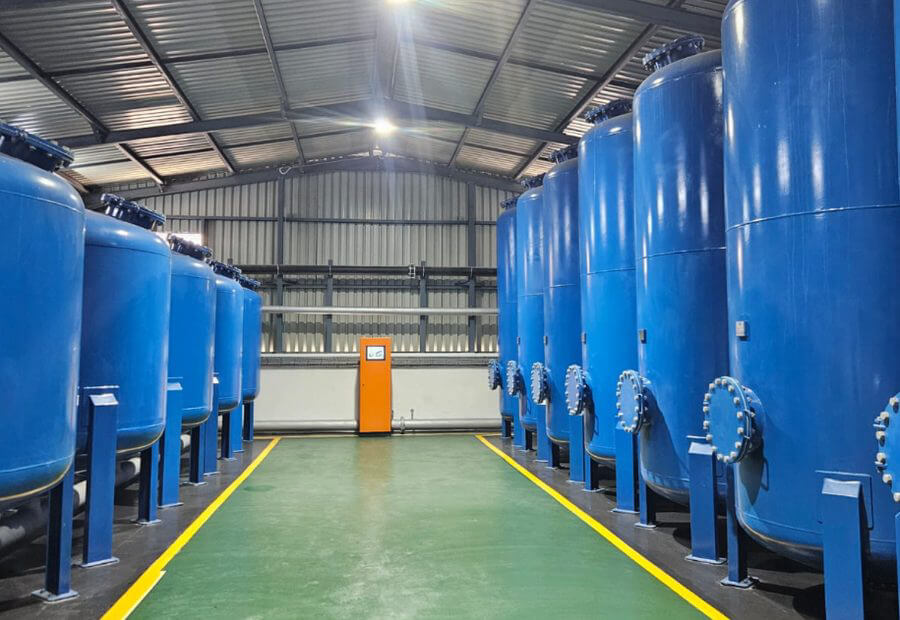
- AFM Filtration — 5 Vessels
Activated filter media as primary barrier, taking turbidity and particulate organics out ahead of the carbon – protecting adsorption capacity that should be spent on odour compounds, not solids. - GAC Filter Bank
Granular activated carbon sized for the contact time adsorption needs at 220 m³/hr, continuously. Adsorption is the only mechanism that reliably takes MIB and geosmin down at this scale. - Chlorine Dioxide Dosing
Carbon strips disinfectant residual, so treated water is re-dosed with ClO2 into the main plant feed — wider pH range, biofilm control through the reticulation, and none of the chlorophenolic by-products that would undo the carbon’s work.
The Result
Incoming 2-MIB and geosmin above 20 ng/l, treated to below 10 ng/l – held there on continuous 24 hour duty, with a chlorine dioxide residual carried through to the plant.